Material Selection
Materials for prototypes and custom production parts.
Compare common engineering metals and plastics for CNC machining, additive manufacturing, casting, and molding.
Start With The Application
Choose material by function, environment, and process.
Strength, weight, temperature, chemical exposure, appearance, tolerance, and production quantity all influence the final choice.
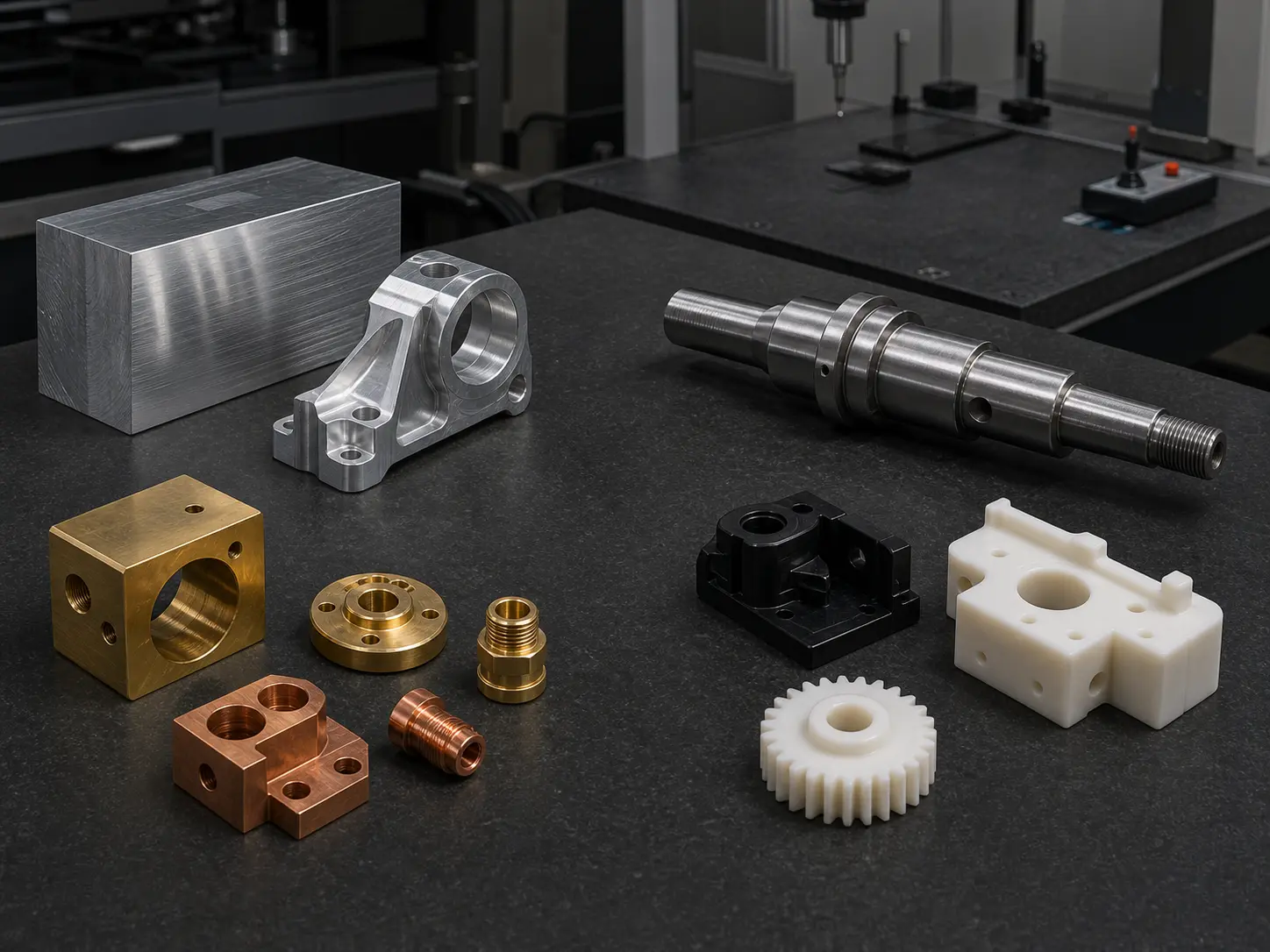
Common Families
Practical starting points for engineering review.
Aluminum
Lightweight, machinable, and suitable for anodized prototypes, housings, brackets, and fixtures.
Stainless Steel
Corrosion resistance and strength for mechanical, food-contact, and industrial applications.
Engineering Plastics
ABS, PC, POM, PMMA, nylon, PEEK, and other grades for functional or appearance parts.
Copper Alloys
Brass and copper options for electrical, thermal, decorative, and precision components.
Material Comparison
Shortlist materials before requesting a quote.
| Material | Typical strengths | Typical applications |
|---|---|---|
| Aluminum 6061 | Balanced machinability, weight, and finish options | Housings, brackets, fixtures, prototype assemblies |
| Aluminum 7075 | Higher strength-to-weight ratio | Robotics, aerospace-style prototypes, load-bearing parts |
| Stainless Steel 304 | Corrosion resistance and clean appearance | Industrial hardware, covers, fluid-contact components |
| POM / Acetal | Low friction and dimensional stability | Gears, spacers, guides, wear components |
| PC / PMMA | Transparent or impact-resistant options | Covers, light guides, visual prototypes |
| Nylon / PA | Toughness and additive-manufacturing versatility | Functional prototypes, clips, housings, mechanisms |
Finishing Compatibility
Material and finish should be reviewed together.
Anodizing, plating, polishing, painting, blasting, dyeing, texture, and marking can change dimensions, appearance, and cost.
- Call out cosmetic surfaces on drawings
- Separate functional and appearance requirements
- Confirm masking and critical dimensions
- Use samples or color standards when available
Material Review
Share the application, not only the grade.
Send CAD, drawings, quantity, environment, and performance needs for a practical recommendation.